


Baienfurt - Home of the Carding Machine
The carding world of Allgäu is based in Upper Swabia. Very close by is the wonderful community of Baienfurt.
The head of the carding comb adorns the town's coat of arms for good reason. Because the community historically achieved prosperity through carding, among other things.
In Baienfurt, you can still follow the traces of that time today in Germany's only "Carding Museum".
Aerial photo: Werner Riehm (FLY-FOTO.de).

Diverse past
Regardless of Baienfurt, the teasel has a long and significant history. "Of course!" one might think – it traditionally has healing effects: In the Middle Ages, preparations made from the root of the teasel were applied externally for cracks, warts, small wounds, styes, fistulas, lichen, and taken internally for liver complaints or stomach ailments.
That is also correct, but it is not the reason for the teasel's fame or the importance of cultivation regions like Baienfurt. In folk medicine, the teasel is almost always used in its first year of growth. Since it only develops its stem in the second year, its head cannot be significant here.
In traditional textile processing, however, it is almost exclusively the wonderfully spiky head of the plant that matters. This is excellent for "scratching" or "roughening" fabric.
The term "carding" refers to another process, which is still called that today…
About "Carding" and "Fulling"
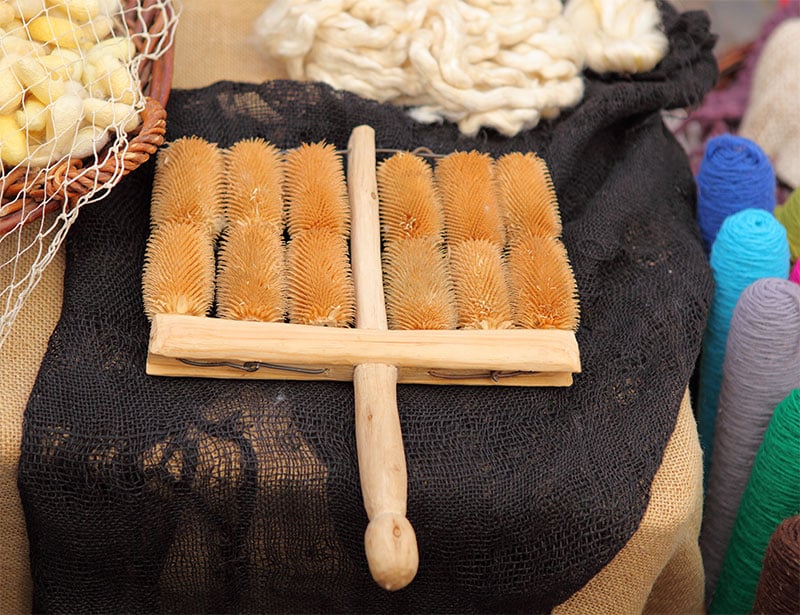
Before a fabric is created, the individual threads of wool must be freed and aligned in a parallel layer. Arranged this way, they are suitable for yarn or fabric. This process is called "carding" or "combing". The machine used for this is simply called a "carder." When carding by hand or with machines, the heads of the carder were used because of their shape.
In traditional crafts, wooden "carders" are still used today. They come in different designs to produce increasingly finer fleece bands. The picture shows such a "hand carder".
Around 1830, the process of "carding" became increasingly automated. At first, the head of the carder was still used in the machines. There was therefore a huge demand for weaver's carders. The growing regions – such as Baienfurt – experienced unexpected profits and led to prosperity.
Through new manufacturing techniques, the head of the weaver's carder was later replaced by corresponding forms, and the carder lost significance in this area.
The first machines
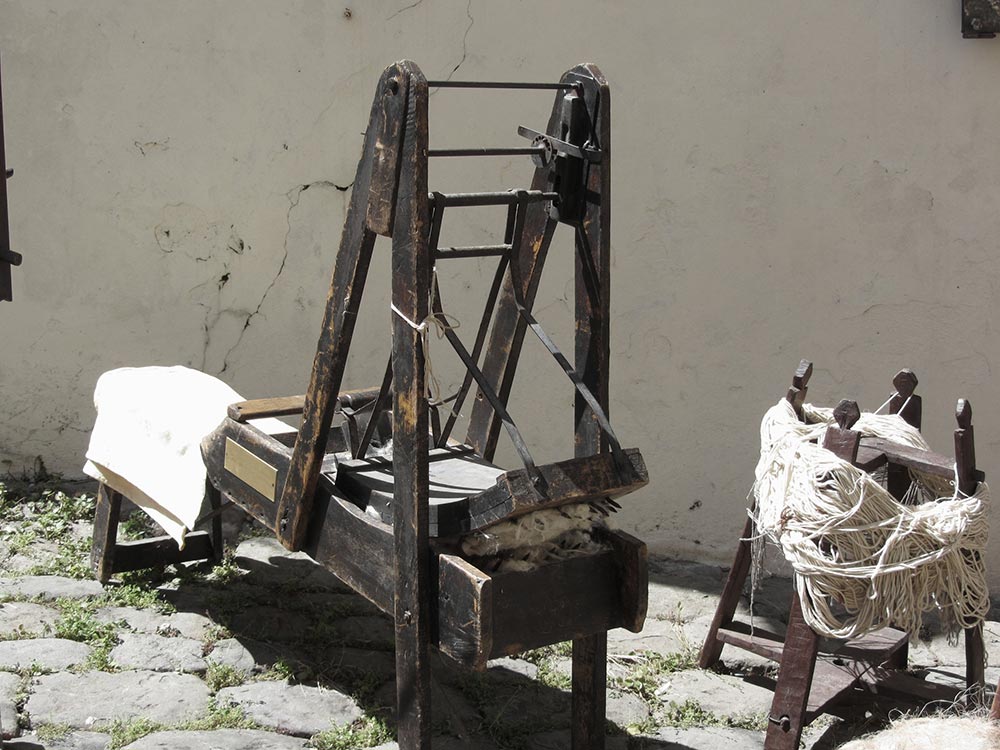
The first "carding machines" were true marvels of their time. They were already able to produce enough fabric for the beginnings of industrial textile manufacturing.
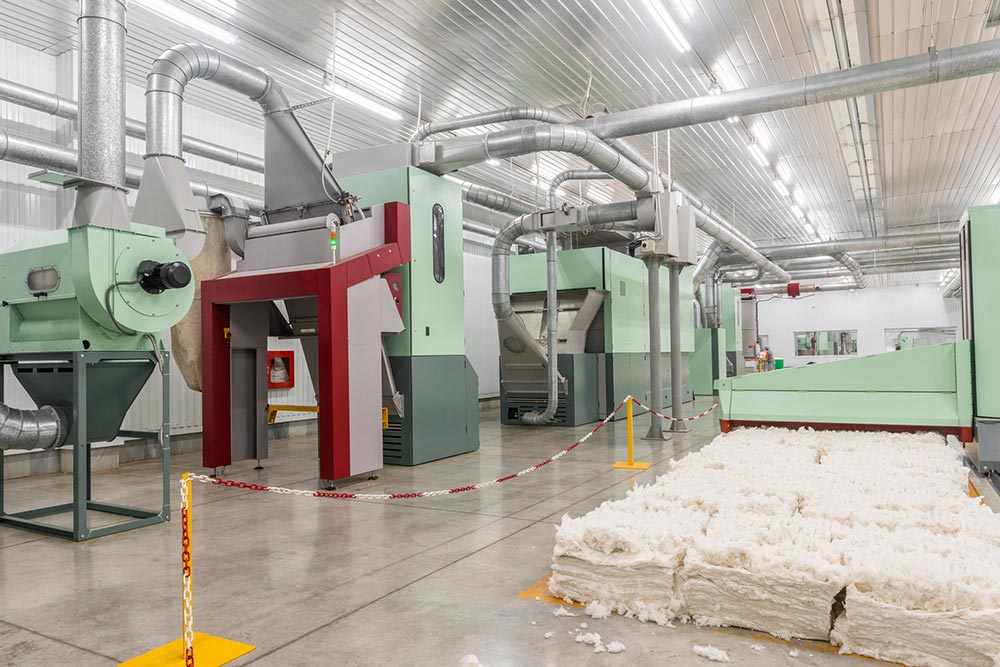
In contrast, modern carding machines actually look quite boring – at least in our opinion.
The picture shows one such "card" from the early days.
Modern "Carding Machines"
Faster, cheaper, higher quantities, and higher profits through sheer volume.
Characteristics of the modern textile industry.
Did we promise too much?… Boring compared to the old “card” :-).

The modern meaning of the burdock
In today's world, the teasel has only symbolic significance in the textile industry. It is the namesake of the "carding machines."
However, many people are learning to appreciate it more and more through its presence in natural medicine. Traditionally, this has always been the case, as the wild teasel is also a helpful component in Traditional Chinese Medicine (TCM).
The Allgäu author Wolf-Dieter Storl has even dedicated an entire book to this wonderful plant: “Naturally Healing Lyme Disease” (published by AT-Verlag). You can also find this book in our book corner. Just take a look. Mr. Storl is a real storyteller and captivates readers not only in his lectures.
We wish you much enjoyment.
