

About the Karde
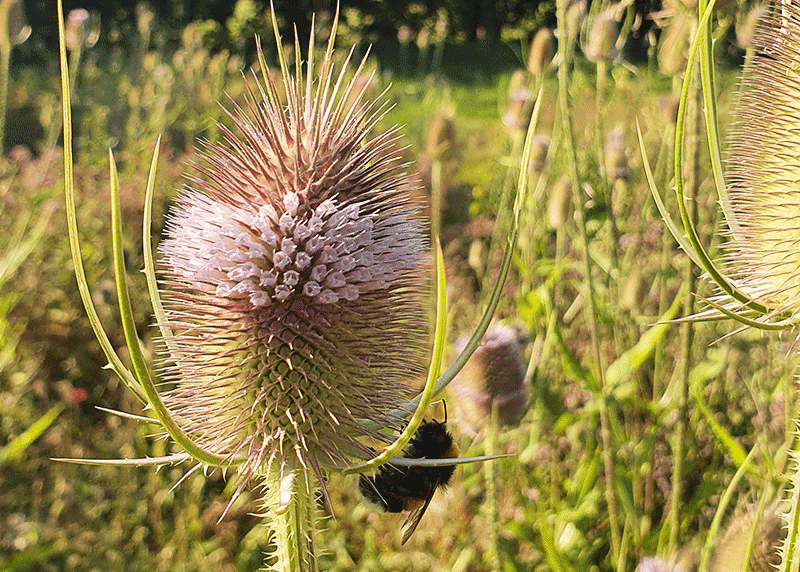
“I also have the teasel in my garden.” We often hear this from our customers. In fact, this term is incorrect because the teasel is not a thistle.
The wild teasel is native throughout Europe and quite well known – yet its botanical classification is not always clear. Our experience shows this repeatedly, especially with people who want to make their own tinctures: some confuse the wild teasel with similar-looking plants.
As true fans of this amazing plant, we take this opportunity to classify the wild teasel botanically.
The wild teasel belongs – with all its genera – to the teasel family. Although they look thistle-like, they are not thistles.
Interesting, isn’t it? Now it gets even more botanical and specific.
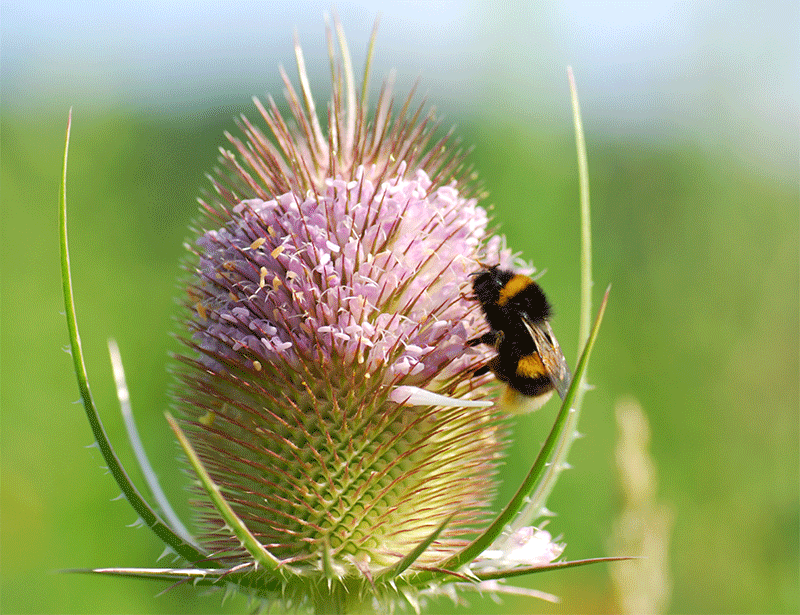
The family of teasel plants includes the following genera:
- Teasel Dipsacus
- Field scabious Knautia
- Scabious Scabiosa
- Devil's bit Succisa
The genus "teasel" includes the following species:
- Wild teasel
- Slit-leaved teasel
- Hairy teasel
- Slim teasel
For us at Kardenwelt, the wild teasel and the so-called fuller's teasel are relevant. The currently valid botanical name of the wild teasel is "Dipsacus Fullonum", which means "thistle of the cloth maker." This is misleading, as the fuller's teasel was previously used for raising fabric, "Dipsacus Sativus." However, it does not descend from the wild teasel but from the Mediterranean teasel species "Dipsacus Ferox."
And to complete the confusion: The fuller's teasel used to be called "Dipsacus Fullonum" – which, as mentioned, is now assigned to the wild teasel. We admit, the classification is not that simple. What we want to tell you here: In the book "Borreliose natürlich heilen" (Naturally Healing Lyme Disease), Wolf-Dieter Storl shows a fuller's teasel on page 148, not a wild teasel.

A plant with a past
The wild teasel has an exciting history: it is still firmly rooted in Traditional Chinese Medicine today. Maria Treben – known to many – also used it for healing purposes. By the way, very similarly to how Wolf-Dieter Storl does today, for example in the book "Naturally Healing Lyme Disease".
Apart from natural medicine, the spiky head of the teasel was specifically used to soften textiles until it was replaced by chemicals. This was still the case during the industrial era.
Even today, the textile industry uses the term “carding.” What exactly this means and whether the term actually comes from the teasel (spoiler: yes, it does) can be read in our historical summary.
